
ERP Examples in Real Life: Discrete Manufacturing Use Cases and Documented Cases
What counts as a real-life ERP example
A real-life ERP example connects a specific operational problem to a product model, production flow, and information requirement. It is more useful than a list of system names because it shows what the business needed to control and what the ERP record had to represent.
For a discrete manufacturer, that context starts with identifiable parts and individual units assembled from distinct components. Automotive components, aerospace equipment, industrial machinery, and electronics fit this pattern. The corresponding ERP model commonly uses bills of materials, routings, work orders, assemblies, serial numbers, engineering changes, and individual units.
This article separates two kinds of examples:
- A documented case describes a named organization, process, or teaching scenario reported by an identifiable source.
- An illustrative use case describes a credible operational situation supported by general ERP and discrete-manufacturing information, but it does not prove that a particular company deployed a particular product or achieved a particular result.
That distinction changes how you use the example. A documented case can show how a known problem appeared in a real operation. An illustrative use case can help you form evaluation questions. Neither type, by itself, establishes that a system is suitable for your plant.
The boundary also matters. Discrete manufacturing works with countable products, assemblies, and subassemblies.. If your operation builds assembled products, examples involving bills of materials, routings, work orders, inventory units, and production sequencing are more relevant starting points than examples built around bulk formulas or batch yields.
Use each example to ask three questions: What problem did it address? What records or decisions were involved? What part of the example resembles your own operation?
Start with the discrete-manufacturing operating model
A discrete-manufacturing operating model describes how your company defines a product, plans its components, performs work, records progress, and delivers the finished unit. The model is the first filter for any ERP example because the same feature label can represent different workflows in different manufacturing environments.
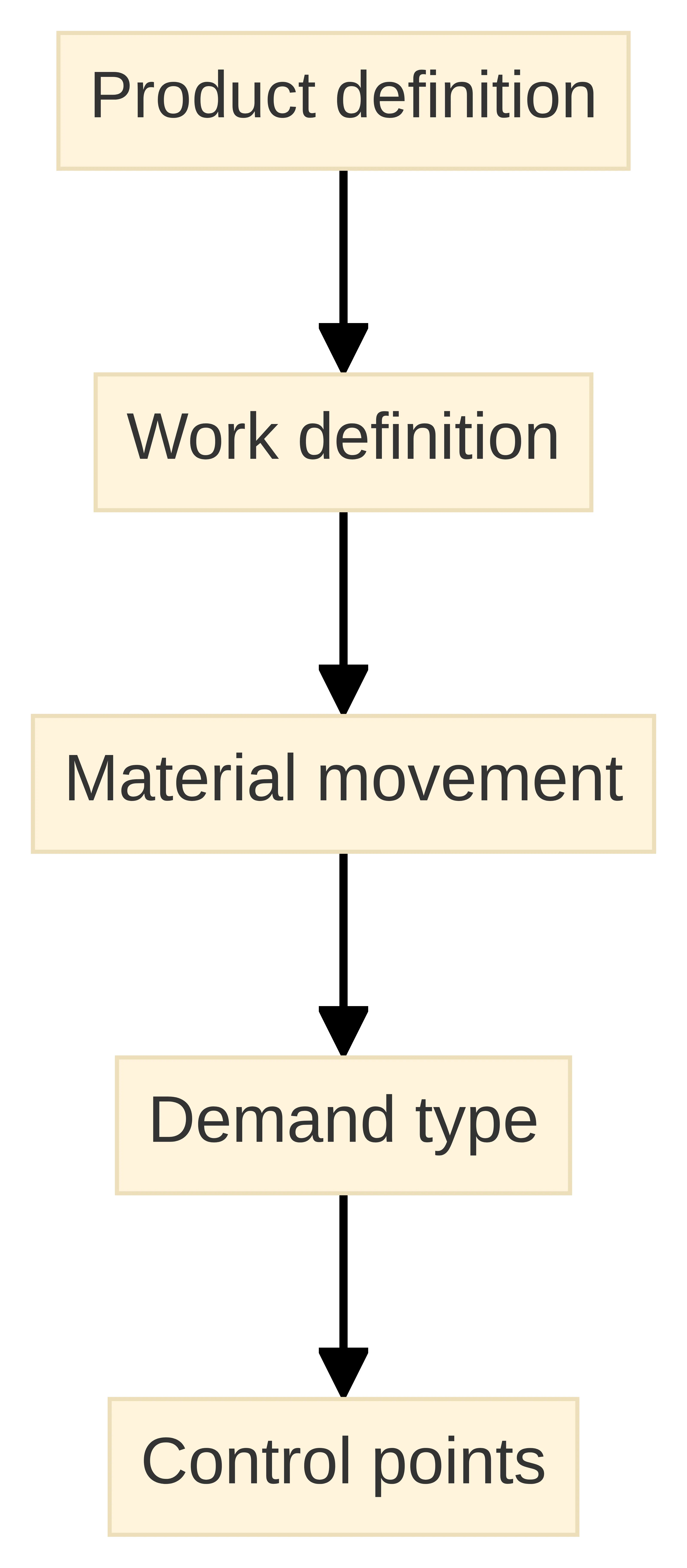
For assembled products, examine the flow in this order:
- Product definition: Identify the components, subassemblies, quantities, specifications, and approved changes that define the finished product.
- Work definition: Identify the routing, work centers, operation sequence, and work order structure used to build it.
- Material movement: Follow raw materials, purchased parts, subassemblies, work in process, and finished goods through the operation.
- Demand type: Establish whether the operation is primarily make-to-stock, make-to-order, or engineer-to-order.
- Control points: Mark where planning, scheduling, costing, quality, traceability, and production reporting affect a decision.
This sequence gives you a way to compare an example with your own environment without assuming that every ERP handles manufacturing in the same way. The manufacturing model affects how an ERP handles bills of materials, routings, work orders, scheduling, costing, inventory, quality, traceability, and production reporting.
A product may move through several operations before it becomes a finished unit. A bill of materials identifies the required components and subassemblies, while routing information places the work centers and operations in sequence. That distinction is useful when you read a case: an example about financial consolidation may be less relevant to your immediate problem than an example that follows a work-in-process unit through multiple operations.
Start with your operating model, not with a vendor list. The model tells you which examples deserve closer examination.
Example 1: disconnected systems and untracked work in progress
A historical Rolls-Royce ERP case study describes a manufacturing environment in which work in progress moved between sites but could not be tracked accurately. The case study connects that gap with inventory and stock-take problems. It also describes a scheduling system operating on MRP II principles, older manufacturing systems at different facilities, and additional systems supporting commercial, financial, and procurement functions.
The operational problem was not simply that several applications existed. The problem was that the systems did not maintain a dependable view of material and work as it crossed organizational and site boundaries. When a partially completed unit moved from one facility to another, the record did not reliably follow it. That made inventory positions and stock-taking harder to reconcile.
For an operations manager, the example points to a specific evaluation question: Can your proposed operating model preserve the identity, status, location, and ownership of work in process when that work moves between departments or sites? The question applies especially when production includes shared facilities, inter-site transfers, or multiple systems involved in one transaction.
The same case study describes separate commercial, financial, and procurement systems with interface problems caused by different databases and file formats. That detail broadens the lesson beyond shop-floor tracking. A production issue can become an inventory issue, a procurement issue, or a financial reconciliation issue when the underlying records do not connect cleanly.
Treat this as a documented problem pattern, not as a general statement about every multi-site manufacturer. The case gives you a concrete way to inspect handoffs: identify the transaction, identify the system that owns it, and ask what the next department receives.
What the Rolls-Royce case demonstrates—and does not prove
The Rolls-Royce case demonstrates why work-in-process visibility and system interfaces deserve separate attention during ERP evaluation. It shows a historical situation in which inaccurate tracking across sites contributed to inventory and stock-take problems, while different databases and file formats complicated communication among commercial, financial, and procurement systems.
The case does not establish that a particular modern ERP product would solve the problem. It does not establish a current product capability, a successful implementation outcome, a price, or a universal design for every aerospace or discrete manufacturer. It also does not tell you whether your own operation has the same site structure, transaction volume, routing complexity, or system boundary.
Use the example as a problem-to-question conversion:
- Document the movement of work in process between each site or department.
- Identify where inventory status changes and who records the change.
- List the interfaces that carry commercial, financial, procurement, and production information.
- Mark each point where a missing, delayed, or inconsistent record could affect a decision.
The practical boundary is clear: the case supports investigation of cross-site records and interfaces. It does not support a product recommendation.
Example 2: following a product through multiple production modes
A SAP Learning course uses a bike company as a teaching example. The production flow begins with assembling raw materials, continues through modification of semi-finished goods such as painted tubes, and ends with final assembly. The course states that different stages can be modeled using repetitive, process, and discrete manufacturing processes.
This is a documented teaching example rather than a report of a named company’s ERP deployment or implementation result. Its value comes from the way it follows a product through stages instead of treating manufacturing as a single undifferentiated activity.
The example gives you a useful way to inspect mixed production flows. A bike may contain countable components and assemblies, yet some intermediate work can be represented differently from the final discrete assembly. In your own operation, ask whether every stage uses the same product structure, work definition, tracking approach, and completion record. If not, the transition between stages deserves its own evaluation question.
The example is relevant to an assembled-product manufacturer when a product passes through fabrication, modification, subassembly, and final assembly. It can also help you examine whether a proposed ERP model follows the product as its status changes from raw material to semi-finished good to finished unit.
Do not extend the example beyond its evidence. It does not identify a commercial deployment, name an implementation outcome, or establish that every bike manufacturer uses the same production model. Use it to map transitions in your own flow, then test those transitions against documented requirements.
What the bike example reveals about production fit
The bike example reveals that production fit is about the relationship between stages, not only the presence of isolated manufacturing features. A system may need to represent a component, a semi-finished assembly, a modification step, and a final product without losing the relationship among them.
That observation leads to four practical checks:
- Product structure: Can you describe the components and subassemblies at each stage?
- Work sequence: Can you show which operation happens before the next operation?
- Status transition: Can you distinguish material that is purchased, being modified, in work, or complete?
- Production model: Can you explain where your operation is discrete, repetitive, or otherwise different in its work pattern?
The manufacturing model affects bills of materials, routings, work orders, scheduling, costing, inventory, quality, traceability, and production reporting. Those are not separate questions when your product changes form during production. They are connected parts of the same flow.
The teaching example does not prove that a particular product configuration is appropriate for your plant. It gives you a documented production scenario to use when framing questions. Keep the scenario attached to the question it helps answer: how should an ERP represent a product that moves through multiple production modes before final assembly?
Illustrative use case: planning materials for assembled products
Material planning is a useful illustrative ERP use case when customer demand must be translated into the components and quantities required for assembled products. A guide published in 2023 describes material requirements planning as a way to plan and manage raw materials, maintain inventory levels, and help reduce stockouts or excess inventory. ERP Software Guide’s manufacturing guidance describes production planning as translating customer demand into work orders, calculating material and capacity requirements, and tracking actual versus estimated job costs.
In practical terms, the use case starts with a product definition and a demand signal. The planning question is not simply whether a component exists in inventory. It is whether the required component, quantity, timing, and related production work can be identified for the order or plan in front of you.
Use this example when your concern involves:
- shortages that interrupt an assembly;
- excess material that remains after demand changes;
- a bill of materials that must drive component requirements;
- work orders that need material and capacity information; or
- differences between estimated and actual job costs.
This is an illustrative use case. The sources support the planning functions and the operational questions, but they do not document a particular manufacturer using a named ERP product for this scenario or establish a specific reduction in shortages, excess inventory, or cost.
To compare the example with your operation, choose one assembled product and trace its demand through the bill of materials and planned work. Record where the process needs component quantities, timing, work-order creation, capacity information, or cost comparison. The example is relevant if those are the decisions you need to make; it is not relevant merely because a system brochure uses the phrase MRP.
Illustrative use case: coordinating shop-floor work and inventory
Shop-floor coordination is another illustrative use case. A discrete-manufacturing ERP guide describes shop-floor control as monitoring production progress, allocating resources, and managing workflow. The same guide describes inventory tracking, real-time inventory visibility, and support for automatic replenishment mechanisms.
Together, those functions describe a coordination problem: you need to understand what work has been planned, what work is progressing, what resources are assigned, and what material remains available for the next operation. The example is especially useful when production status and inventory status are maintained separately or when an operations manager must assemble a view from several records.
A practical scenario might follow a work order through these questions:
- What product or subassembly is the work order for?
- Which operation should happen next?
- What material is required before that operation can begin?
- What resource or work center is assigned?
- What completion or issue transaction changes the status of the work and material?
The list is a decision map, not a claim that every ERP handles these steps in the same way. Use it to describe the record flow you need to test.
The supporting guide is dated 2023, so treat its descriptions as a general capability framework rather than proof of a product’s status on October 27, 2026. Confirm any specific product behavior separately during your evaluation. The example itself supports questions about progress, resources, workflow, and inventory records; it does not prove a production result or a particular implementation outcome.
Illustrative use case: connecting demand to production and departments
A demand-to-production use case follows a customer requirement into work orders, material and capacity requirements, job-cost tracking, and shop-floor visibility. ERP Software Guide’s manufacturing guidance describes those links as part of production planning for manufacturers. Its ERP FAQ describes ERP software as connecting finance, inventory, production, purchasing, sales, and often human resources through shared data. Its ERP guide also describes a centralized database as a way to connect departments, reduce duplicated data, and provide a single source of truth for critical business information.
For you, the operational question is whether a customer order, forecast, or other demand signal can be connected to the records that production, purchasing, inventory, and finance need to act. A useful example should show the handoffs rather than stopping at the sales order or the work order.
Map the example through these departments:
- Sales or customer service records the demand and required product.
- Production planning translates that demand into work and material requirements.
- Purchasing responds to required externally sourced material.
- Inventory records receipts, issues, transfers, and available stock.
- Production records progress and completion.
- Finance receives the transactions needed for job-cost or financial records.
This is an illustrative cross-department use case. The accepted descriptions support the connections and data relationships, but they do not establish that every ERP provides the same integration depth or that shared data automatically produces better operational decisions.
The example is relevant when your problem involves duplicate records, delayed handoffs, conflicting inventory information, or uncertainty about the financial effect of production activity. It is less useful if your immediate question concerns only a narrow production task with no connection to demand, purchasing, inventory, or finance.
Do not treat a centralized record as a substitute for a defined process. First identify which transaction each department needs, then ask how that transaction should move through the operation.
Illustrative use case: quality and traceability in the product record
Quality and traceability form an illustrative use case when you need to connect a product or component with its production history. A discrete-manufacturing ERP guide describes quality-control capabilities for monitoring and enforcing quality standards during production. A discrete-versus-process manufacturing comparison describes discrete production as tracking individual components through serial numbers or lot traceability and managing quality for individual components and finished products.
Use this example to define the product record you need to follow. Depending on your operation, the record may need to relate a component or finished unit to its bill of materials, work order, operation, status, serial number, lot, inspection point, or quality decision. The point is not to assume that every item requires the same level of traceability. The point is to identify which relationship matters when you investigate a nonconformance, a customer question, a rework decision, or a release decision.
Ask these questions:
- What product, component, or subassembly must be identified?
- Which production or inventory transaction creates the relevant history?
- At which operation does quality information enter the record?
- Which relationship must remain visible after the unit moves to the next stage?
- What information would you need to locate affected units or material?
These questions help you describe the required record structure without claiming that a particular vendor or product provides it.
This example does not establish regulatory compliance, defect reduction, recall performance, or a specific traceability result. It establishes a relevance lens for discrete manufacturing: quality and traceability questions should follow the individual product, component, assembly, or lot through the production flow that your operation actually uses.
Compare examples by the problem they address
The examples become easier to use when you compare their operational problem, evidence basis, and evaluation question rather than treating them as equivalent case studies.
| Example | Problem or process | Evidence basis | Question for your operation |
|---|---|---|---|
| Rolls-Royce case | Work in process moved between sites without accurate tracking; separate commercial, financial, and procurement systems had interface problems. | Historical case study. | Can your records follow work and inventory across sites and departmental boundaries? |
| SAP bike example | A product moved from raw-material assembly through semi-finished modification to final assembly. | Documented teaching example. | Can your product record and work model represent each stage and transition? |
| Materials planning | Raw-material and component requirements must be planned against assembled-product demand. | General capability description and business guidance; illustrative use case. | Can you connect demand, bills of materials, material requirements, and planned work? |
| Shop-floor and inventory coordination | Production progress, resources, workflow, and inventory status need to be considered together. | General capability description; illustrative use case. | Can you define the status and transaction flow needed for the next operation? |
| Demand-to-department flow | Customer demand must connect with production, purchasing, inventory, finance, and sales records. | Business guidance and ERP definition; illustrative use case. | Which departments need the same transaction, and who owns each record? |
| Quality and traceability | Individual components, assemblies, or finished products need a connected production and quality history. | General discrete-manufacturing description; illustrative use case. | Which product identity, quality event, and production relationship must remain visible? |
The first two examples are documented scenarios, but neither is a vendor comparison. The remaining examples are practical models for framing requirements, not proof that a named system has delivered a result.
Apply a relevance test to your own operation
A relevant example resembles your product model and production flow, addresses a problem you can describe, and gives you a question you can test. Use the following relevance test before placing an example on your shortlist.
- Product fit: Do you build identifiable parts, assemblies, or finished units from distinct components? If the example centers on formulas, recipes, or batch yields, it belongs to a different manufacturing context.
- Structure fit: Does the example use the kind of bills of materials, subassemblies, routings, work orders, serial numbers, or engineering changes that your products require?
- Flow fit: Does the example follow a production sequence similar to yours, including fabrication, modification, subassembly, final assembly, or movement between sites?
- Demand fit: Does it address make-to-stock, make-to-order, or engineer-to-order work in a way that resembles your order pattern?
- Problem fit: Does it address the operational issue you need to investigate, such as material planning, shop-floor status, inventory movement, cross-department data, quality, or traceability?
- Decision fit: Does it help you define a decision, record, or handoff that you can test in your own process?
- Evidence fit: Is the example a documented case, a teaching scenario, or an illustrative use case? Can you state exactly what it demonstrates and where its boundary lies?
Mark an example as a closer match when it passes the product, flow, problem, and evidence tests. Mark it as a background example when it helps explain a concept but does not resemble your transaction flow closely enough to guide further evaluation.
Apply the test to one product family rather than to your entire business at first. Write down the product structure, the production stages, the demand type, and the point where your current information becomes difficult to use. Then compare the example against that description.
If the example matches only a general feature, keep it as background. If it matches a specific product flow and operational problem, turn it into a requirement or demonstration question. That boundary prevents a familiar phrase such as real-time visibility or MRP from becoming a substitute for a defined need.
Record the evidence before shortlisting an example
A short evidence record keeps a documented case separate from an illustrative use case and makes your shortlist easier to challenge. Create one record for each example with these fields:
- Example name: Use a plain label that identifies the case or operational scenario.
- Manufacturing context: Describe the assembled product, product family, site structure, and production flow involved.
- Operational problem: State the issue in one sentence, such as inaccurate work-in-process tracking or unclear material requirements.
- Process covered: List the relevant steps, from demand and product definition through planning, production, inventory, quality, or shipment.
- Evidence type: Mark the example as a documented organizational case, a documented teaching example, or an illustrative use case.
- Supported conclusion: Write only what the source directly demonstrates.
- Boundary: Record what the example cannot establish, such as a current product capability, price, implementation outcome, or fit for your plant.
- Evaluation question: Turn the supported conclusion into a question about your own records, decisions, or handoffs.
For the Rolls-Royce example, the supported conclusion concerns historical work-in-process tracking and interface problems. For the bike example, it concerns a teaching flow from raw-material assembly through modification and final assembly. For the planning and shop-floor examples, the supported conclusion concerns the operational questions that discrete-manufacturing ERP functions are intended to address, not a named deployment.
A compact record can look like this:
Example:
Problem addressed:
Product and production flow:
Evidence type:
What the example demonstrates:
What it does not establish:
Question to test in your operation:
Fill in the record before you rank or compare systems. The immediate use of this template is to keep the example, its operational relevance, and its limits in the same place. It does not create a result or establish suitability by itself.
What these examples cannot establish
These examples cannot establish that a particular ERP product is suitable for your operation. A historical case describes a past organizational problem. A teaching example explains a production flow. An illustrative use case helps you frame a requirement. None of those forms proves current product capability, implementation quality, pricing, return on investment, or fit for your plants.
They also cannot establish a vendor ranking. The examples do not provide a common comparison method, a defined set of vendors, a consistent test environment, or a current evaluation of product releases. Do not convert a problem description into a product conclusion.
The examples cannot establish that shared data will automatically improve planning, inventory, quality, or production decisions. Shared records can clarify what information connects, but your operating rules, data definitions, responsibilities, and transaction discipline still determine how the information is used.
Finally, the examples cannot establish that your operation has the same constraints as Rolls-Royce, the same staged flow as the bike teaching example, or the same planning and tracking requirements described in the general guides. Use the examples to form questions, then answer those questions with your own product structures, transactions, handoffs, and evaluation criteria.
Use the evidence-backed shortlist as the next research step
Your shortlist should contain examples that match your assembled products, production flow, operational problem, and required records. Keep the Rolls-Royce case for questions about cross-site work-in-process tracking and interfaces. Keep the bike example for questions about products that move through several production modes. Use the planning, shop-floor, demand, department, quality, and traceability scenarios to turn your own needs into testable requirements.
Before you move from examples to system evaluation, make sure each entry states what it demonstrates, what it cannot establish, and what question you will test. A qualified professional should determine individual suitability for your operation. The next conversation can then focus on your documented product model, transactions, and decision points rather than on an undifferentiated list of ERP names.
What should you verify before treating an ERP example as relevant?
What defines a real-life ERP example in discrete manufacturing?
A real-life ERP example connects a specific operational problem to a product model, production flow, and information requirement, demonstrating how a business needed to control its processes and what the ERP system had to represent.
How do documented cases differ from illustrative use cases in ERP examples?
Documented cases describe named organizations or processes reported by identifiable sources, while illustrative use cases present credible operational situations supported by general ERP information but do not prove specific deployments or results.
What operational problems do ERP examples typically address in discrete manufacturing?
ERP examples in discrete manufacturing often address issues such as work-in-process tracking, material planning, inventory management, quality control, and the integration of production with other business functions.
How can I evaluate the relevance of an ERP example to my own operations?
To evaluate relevance, consider factors like product fit, structure fit, flow fit, demand fit, problem fit, decision fit, and the type of evidence supporting the example.
What are some common operational needs that ERP systems address in discrete manufacturing?
Common operational needs include managing bills of materials, tracking inventory, ensuring quality control, planning production schedules, and coordinating resources across departments.
What limitations should I be aware of when using ERP examples for evaluation?
ERP examples cannot establish current product capabilities, implementation outcomes, or vendor rankings. They serve to frame questions rather than provide definitive proof of suitability for your specific operation.
Keep reading
Related articles
Free account
Create A Free Account
Get the clarity you need to make confident ERP decisions — without the sales pressure.
- Read every article (past & future)
- Compare ERP systems side by side
- Access exclusive guides, checklists, and cost breakdowns
- Stay current on industry updates and trends
Get expert guidance at no cost
Rather talk to a specialist?
Book a free call with one of our ERP specialists for a no-obligation needs assessment. We'll help you understand your options, cut through the noise, and figure out what actually makes sense for your business — before you ever talk to a vendor.
Book A Free Call