
ERP Software Examples for Discrete Manufacturing: Candidates for a Defensible Shortlist
What an ERP software example means for a discrete manufacturer
ERP software is business-management software that centralizes applications for functions such as supply chain, inventory, and financial management, with access to shared operational data. A named product becomes relevant to your shortlist when its documented scope can be tested against the way your company defines products, plans production, manages materials, records quality activity, and controls financial information.
Discrete manufacturing ERP supports operational areas such as inventory management, production scheduling, and quality control. Those areas matter when you make assembled products from identifiable parts, subassemblies, bills of material, work orders, and production steps. Aerospace components, automotive assemblies, electronic equipment, and medical devices can all require different controls, but the shortlist question is similar: can the system represent your products and connect the work needed to produce them?
Use the examples below as research candidates, not as a universal ranking. The purpose of an initial list is to identify systems that deserve structured questions, demonstrations, and fit checks. A name belongs on the next research stage only when its scope matches your operation and the vendor can answer the same operational questions you ask of every other candidate.
An ERP software example therefore has two parts: a named system and a reason to investigate it. Record the manufacturing model, workflow, or scale question that puts each name on your list. That record gives your team a basis for removing a candidate without turning familiarity into a recommendation.
The operational boundary: discrete manufacturing is not process manufacturing
Discrete manufacturing and process manufacturing use different operating models, so a system associated with one model should not automatically be treated as suitable for the other. Discrete-manufacturing requirements usually center on identifiable items, structured components, production orders, operations, and quantities that remain distinguishable through assembly. Process requirements can instead depend on formulas, yields, transformation batches, co-products, by-products, catch-weight processing, and expiration management.
A discrete-manufacturing ERP generally should not be assumed to handle those process-manufacturing requirements well. That boundary matters for a food, beverage, pharmaceutical, chemical, or other process operation, but it also helps an assembled-product manufacturer avoid evaluating systems against the wrong problem. Your research should begin with the production model you actually run.
Use the boundary as a screening question:
- If your products are assembled from identifiable components, test product structures, work orders, scheduling, materials, shop-floor activity, and quality records.
- If your operation depends on formulas, transformation batches, yields, or expiration controls, do not treat a discrete label as enough evidence of fit.
- If your plant combines models, require the candidate to demonstrate the specific mixed requirements rather than assuming that broad manufacturing language covers them.
The boundary is a filter, not a verdict on a named system. Advance only the candidates that can address the manufacturing model you need to control.
The candidate ERP examples to investigate
These names give you a starting set for research across enterprise and manufacturing-focused options; they do not establish equal scope, current capabilities, pricing, implementation effort, or fit for your company.
The list should remain open to other systems that meet your requirements. It should also remain temporary. Treat each name as a prompt to gather product-specific answers, not as proof that the system supports your bills of material, production model, quality controls, supply-chain structure, or financial reporting.
Microsoft Dynamics is identified as an ERP and CRM product line, and Oracle NetSuite appears among Oracle’s ERP-related products in an ERP software directory. That identification explains why both names may appear during broad ERP research, but it does not establish the current scope or manufacturing fit of a particular edition. Use current, product-specific documentation and structured demonstrations before advancing either name.
For an operations manager, the useful output at this stage is not a winner. It is a controlled set of candidates with a clear reason for investigation, an owner for each question, and a disposition such as advance, investigate, or remove. Keep the list short enough that your team can apply the same test to every remaining option.
Microsoft Dynamics is identified as an ERP and CRM product line, and Oracle NetSuite is listed among Oracle’s ERP-related products.
The general capabilities behind a credible ERP example
A credible manufacturing ERP candidate should be assessed against the operating areas that make the system an enterprise platform rather than a collection of isolated tools. ERP is generally described as a centralized platform for applications such as supply chain, inventory, and financial management, with access to shared operational data. Discrete manufacturing ERP also supports areas such as inventory management, production scheduling, and quality control.
For a discrete-manufacturing shortlist, screen the candidate across these operational areas:
- Planning and material requirements: Can the candidate support the planning questions that connect demand, materials, capacity, and production activity?
- Supplier management and purchasing: Can the system support the material and supplier activity your production model depends on?
- Quality control: Can you define the quality records and decisions required by your products and customers?
- Inventory and financial management: Can operational transactions connect with the inventory and financial information your company manages?
Those categories are useful screening lenses, not a promise that every candidate handles them in the same way.
For each capability, record the business event you need to see, the data that must move between steps, and the result your team must be able to review. A category such as planning or quality is too broad to approve by itself. Define the transaction, exception, approval, or report that would show whether the candidate addresses the requirement.
Start with the general baseline, then ask each vendor to show the specific workflow. A system may appear to cover a category while leaving a material requirement, approval, integration, or reporting question unresolved.
Oracle Manufacturing: a supported candidate for broader manufacturing scenarios
Oracle Manufacturing documentation published on May 27, 2026 described cloud capabilities for both discrete and process manufacturing, including production setup, management, execution, and costing. The documentation also described support for configured products made to plan or order and contract manufacturing of standard products made to plan or order.
The same documentation described scenarios in which one or more work-order operations are outsourced to suppliers that provide specialized manufacturing services. Those points make Oracle Manufacturing a candidate for a company whose research questions extend beyond a single straightforward assembly flow, but they do not determine whether the product fits your organization.
Use Oracle Manufacturing as a focused validation case rather than treating broad scope as a conclusion. Ask the team to demonstrate the exact product configuration, production-order, costing, and outsourced-operation situations that matter to you. If your company makes aerospace assemblies, automotive components, electronics, or medical devices, define the records, approvals, revisions, and quality decisions that the demonstration must show.
Keep the product claim separate from the fit judgment. The documented capability establishes what Oracle Manufacturing was described as supporting; your requirements determine whether that support is sufficient, usable, and appropriate for the operation you manage.
Epicor Kinetic: a supported manufacturing-system example with limited evidence
Epicor Kinetic is described as a cloud-based, customizable ERP system for manufacturing companies. The description lists modules for global supply chain management, risk and compliance, employee management, human resources, finance, and business intelligence.
That description gives you a reason to investigate Epicor Kinetic as a manufacturing-system candidate, but it does not establish the detailed behavior of a discrete production workflow. It does not, by itself, answer how the system handles your product structures, revisions, planning rules, shop-floor transactions, quality records, supplier processes, or financial controls.
Use a narrow validation script for this candidate:
- Present a representative assembled product and ask how its structure and revisions are maintained.
- Show the planning decision you need to make when material, capacity, or demand changes.
- Trace a production order from release through operator activity, inspection, completion, and financial treatment.
- Ask how exceptions are recorded and how managers see unresolved work.
Treat Epicor Kinetic as an example that merits structured research, not as a conclusion about fit. A product description can open the investigation; your operational tests decide whether the candidate advances. Keep any unanswered workflow question visible in the shortlist record rather than treating the listed modules as an answer.
Candidates that require additional validation
The candidate names are useful for building a research queue, but a name alone does not establish discrete-manufacturing capability, product scope, deployment terms, cost, or current functionality.
Ask the same questions of each candidate before you spend more evaluation time:
- Which discrete-manufacturing workflows are supported in the edition and deployment you would evaluate?
- How does the system represent products, components, revisions, operations, and production orders?
- Which planning, inventory, purchasing, quality, and financial transactions are included in the proposed scope?
- Which requirements need configuration, extensions, integrations, or manual workarounds?
- What can the vendor demonstrate using a workflow that resembles your aerospace, automotive, electronics, or medical-device operation?
Treat broad directory identification as a prompt for product-level research, not as a capability assessment.
The correct action for every unvalidated name is simple: record the questions, request comparable answers, and remove the candidate if the unresolved gaps affect a non-negotiable requirement. If the gap is material but potentially resolvable, keep the candidate in an investigate status with an owner and a deadline.
Use scale as an initial research filter, not a vendor verdict
ERP scale can help you decide how much scope to investigate first, but scale should not decide the shortlist by itself. A cited ERP tier framework places Tier I systems with the largest global enterprises, typically those with annual revenue of $500 million or more, and describes them as highly scalable and customizable. The same framework describes Upper Tier II systems for rapidly growing midsize to large firms and Lower Tier II systems for small and midsize businesses with more basic multinational support and customization.
Use those descriptions as a research filter:
- If your organization has complex, multinational, or highly varied requirements, examine whether the candidate’s scope and delivery model can support that complexity.
- If your organization is smaller or has a narrower operating model, examine whether the candidate introduces more scope, cost, governance, or implementation burden than your requirements justify.
- If growth is a major concern, distinguish a documented scalability approach from a general statement that the system serves large companies.
Do not convert a tier label into a ranking. A system associated with a larger enterprise segment may be unsuitable for a focused operation, while a system associated with a smaller segment may leave a material requirement unresolved. Match scale to the complexity you must control, the resources you can assign, and the decisions the system must support.
The action is to record scale as one filter alongside operational fit. Keep it subordinate to the requirements that determine whether production can be represented and managed. Ask what additional scope the candidate brings, what your team would need to govern, and which requirements would remain unaddressed at either end of the scale.
Compare each example through operational fit lenses
Operational fit becomes clearer when every candidate is tested through the same lenses.
| Fit lens | Question for your operation | Evidence to request from each candidate |
|---|---|---|
| Planning and materials | How does the system support the planning decision when demand, supply, or production conditions change? | A planning scenario tied to actual material and order constraints |
| Quality control | Which inspections, dispositions, and records are required for your products? | A quality event connected to the relevant item or order |
| Supply and purchasing | How do supplier requirements and purchasing actions connect to production needs? | A material shortage or supplier transaction traced to the affected work |
| Inventory and finance | How do operational transactions connect to inventory and financial management? | A receipt, issue, completion, or adjustment followed through its records |
| Scale and scope | Does the candidate’s scope match your organization’s complexity without leaving material gaps? | A clear boundary between standard functions, configuration, extensions, and integrations |
The table is a comparison tool, not a vendor score. Your team can add a priority, owner, and disposition to each row. Advance a candidate only when its answer addresses the requirement in the way your operation needs, not merely when its presentation uses the same category name.
Keep the test consistent across candidates. If one vendor receives a detailed production scenario while another receives only a general question, the resulting comparison will measure the demonstrations rather than the systems. Record the question, the answer, the unresolved condition, and the decision that follows.
Separate general ERP functions from vendor-specific proof
General ERP functions describe the kind of operating platform you are evaluating. Vendor-specific proof describes what a named product or edition is documented as supporting.
Oracle Manufacturing documentation published on May 27, 2026 described cloud support for discrete and process manufacturing, including production setup, management, execution, and costing. The documentation also described configured products made to plan or order and outsourced work-order operations. Those are product-specific statements about Oracle Manufacturing, not universal properties of every ERP system.
Epicor Kinetic is described as a cloud-based, customizable ERP system for manufacturing companies, and its description lists supply chain, risk and compliance, employee management, human resources, finance, and business intelligence modules. Those statements describe Epicor Kinetic at the level supported by the description; they do not prove that a particular production workflow will meet your requirements.
Keep your evaluation record in two columns:
- General requirement: what the operation needs from an ERP platform.
- Product proof: what the named candidate demonstrates or documents for the edition and scope under consideration.
This separation prevents a general definition from becoming a vendor claim. It also prevents a vendor statement about one function from becoming an assumption about the whole operating model. Add a third field for unresolved conditions when a requirement depends on configuration, an integration, an extension, or a process decision.
Turn the examples into an initial shortlist
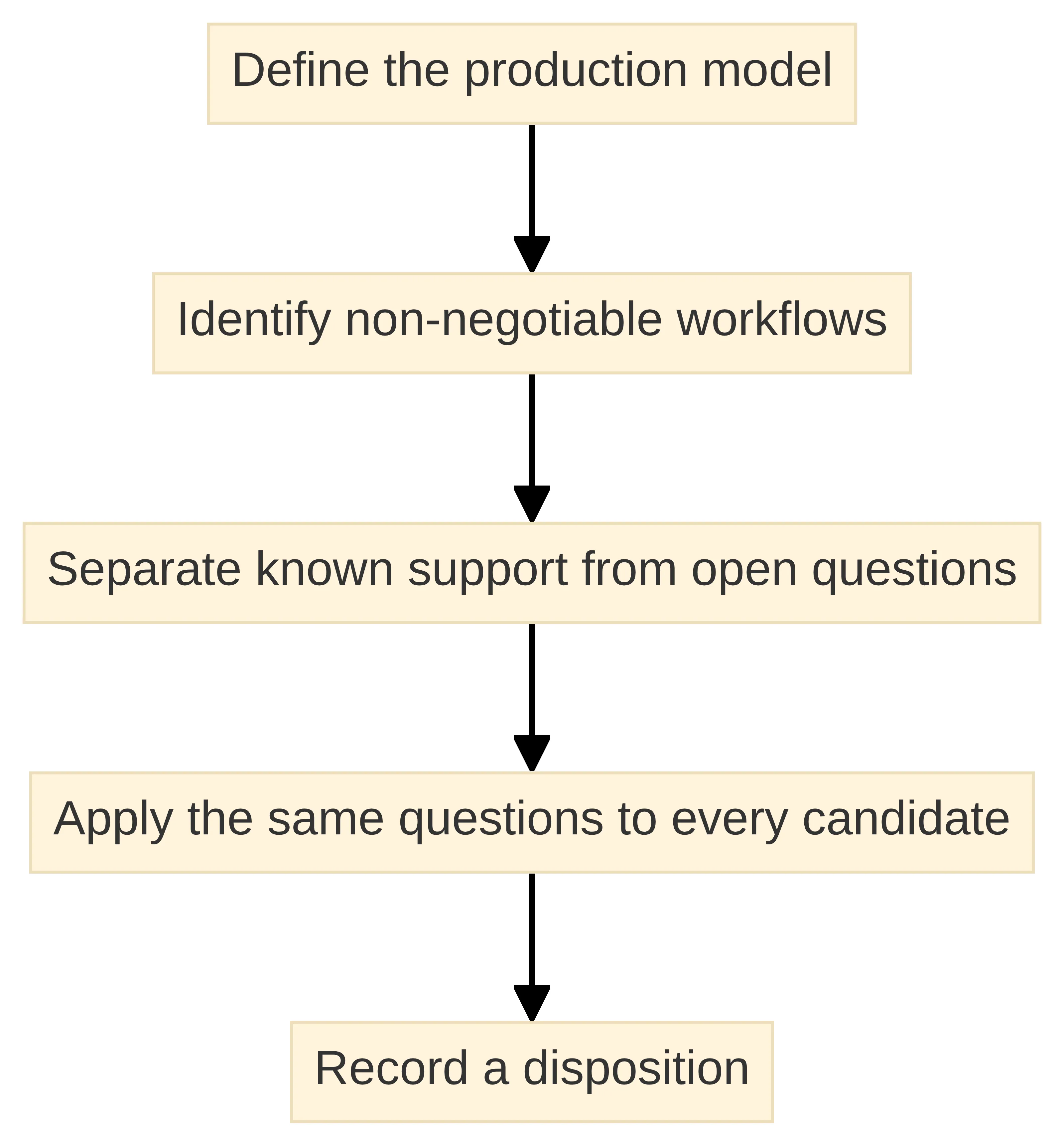
A defensible shortlist starts with requirements that can be tested, not with a familiar product name. Use the candidate list to create a repeatable research path:
- Define the production model. Record whether your company makes assembled products, uses configured products, outsources operations, operates across plants, or combines different manufacturing patterns.
- Identify non-negotiable workflows. Select the product, planning, material, production, quality, purchasing, inventory, and financial activities that must work for your operation.
- Separate known support from open questions. Mark each requirement as demonstrated, documented, requiring clarification, requiring configuration, or unresolved.
- Apply the same questions to every candidate. Comparable questions make gaps easier to see and reduce the risk that a persuasive presentation substitutes for proof.
- Record a disposition. Advance candidates that address the required workflows, hold candidates with defined questions, and remove candidates whose unresolved gaps affect a non-negotiable requirement.
Your shortlist record should preserve the reason each candidate remains under review. “Manufacturing ERP” is not enough. Write the specific operational reason, such as a need to test configured products, outsourced operations, production costing, or a particular quality workflow.
Use the Oracle and Epicor examples as models for how to phrase product-specific questions, not as a reason to give either system automatic priority. Oracle Manufacturing was described as supporting specified manufacturing scenarios, while Epicor Kinetic was described as a cloud-based manufacturing ERP with listed module references. Each candidate still needs the same operational test before you advance it.
Add these fields to the shortlist record:
- Candidate and product edition under review
- Manufacturing workflow being tested
- Requirement owner and priority
- Demonstration or documentation status
- Configuration, integration, or extension dependency
- Open question and next action
- Advance, investigate, or remove disposition
The result should be a smaller set of candidates that your team can compare consistently. It should not be a ranking disguised as a shortlist.
What the available evidence can and cannot establish
Use general ERP functions to set a baseline, then compare each candidate with the operation’s requirements. Treat each conclusion according to the scope of the statement supporting it.
A discrete-manufacturing ERP generally should not be assumed to handle process-manufacturing requirements well, including formula management, transformation batch tracking, co-products and by-products, catch-weight processing, and expiration management. Oracle Manufacturing documentation published on May 27, 2026 separately described support for both discrete and process manufacturing, including production setup, management, execution, and costing. The distinction is product-specific: a general boundary does not override a described capability for a particular system, and a described capability for one system does not become a general rule for all systems.
The available material supports different levels of conclusion:
- General ERP concepts can define the baseline functions you should examine.
- Manufacturing feature categories can organize your questions about bills of material, shop-floor control, planning, suppliers, and purchasing.
- Oracle Manufacturing documentation supports specific statements about manufacturing scenarios, configured products, costing, and outsourced operations.
- The Epicor Kinetic description supports a narrower statement about a cloud-based, customizable manufacturing ERP and listed modules.
- An older ERP software list can identify product families or names, but it cannot establish current product-level manufacturing fit.
Use the narrowest conclusion that answers your question. If a requirement affects whether a candidate advances, require direct product-specific proof before you treat the requirement as satisfied. If the remaining uncertainty does not affect a non-negotiable workflow, record it as an open comparison item rather than treating it as a reason to remove the candidate immediately.
Validate the shortlist against the operation
A useful shortlist connects each candidate to a production model, a required workflow, and a clear proof standard. Start with the general ERP baseline, keep discrete and process requirements separate, use scale only as a filter, and ask every candidate to demonstrate the same operational scenarios. The next decision is not which name sounds strongest; it is which candidates have enough documented and demonstrated fit to justify deeper comparison.
A qualified ERP professional should decide individual suitability against your organization’s requirements, constraints, and operating context. Take unresolved questions into that assessment rather than treating a broad product description as a completed decision.
Which evidence should a sponsor request before advancing an ERP example?
What is ERP software and what makes a system an ERP example?
ERP software is business-management software that centralizes applications for functions such as supply chain, inventory, and financial management, with access to shared operational data. A system qualifies as an ERP example when its documented scope aligns with how a company defines products, plans production, manages materials, records quality activity, and controls financial information.
How can I determine which ERP examples deserve further research?
To decide which ERP examples merit further research, consider the operational fit of each system against your specific production model, workflow requirements, and the ability to manage materials, quality, and financial transactions effectively.
What operational areas should I evaluate when considering ERP systems?
When evaluating ERP systems, focus on operational areas such as product and bill-of-materials management, planning and material requirements, shop-floor control, supplier management, quality control, and the integration of inventory and financial management.
How does the scale of an ERP system impact its suitability for my organization?
The scale of an ERP system can help determine how much scope to investigate. Larger systems may be suitable for complex, multinational operations, while smaller systems may be more appropriate for focused operations. However, scale should not be the sole criterion for selection.
What distinguishes discrete manufacturing ERP from process manufacturing ERP?
Discrete manufacturing ERP focuses on identifiable items and structured components, while process manufacturing ERP relies on formulas, yields, and batch processing. A discrete manufacturing ERP generally should not be assumed to handle process manufacturing requirements effectively.
What should I do if I have unresolved questions about an ERP candidate?
If you have unresolved questions about an ERP candidate, record those questions and request comparable answers from the vendor. If the gaps affect a non-negotiable requirement, consider removing the candidate from your shortlist.
Keep reading
Related articles
Free account
Create A Free Account
Get the clarity you need to make confident ERP decisions — without the sales pressure.
- Read every article (past & future)
- Compare ERP systems side by side
- Access exclusive guides, checklists, and cost breakdowns
- Stay current on industry updates and trends
Get expert guidance at no cost
Rather talk to a specialist?
Book a free call with one of our ERP specialists for a no-obligation needs assessment. We'll help you understand your options, cut through the noise, and figure out what actually makes sense for your business — before you ever talk to a vendor.
Book A Free Call